Full-Arch Dental Implants in Turlock
A complete fixed arch of teeth on four or more implants, for a full upper or lower jaw.
Medically reviewed by Dr. Broneil Ishaya, DDS — Fellow, Misch Resnik Institute of Implantology · California dental license #105491 · Oct 2026 · Written by the Turlock Dental Studio team
In short: Full-arch dental implants replace every tooth in an upper or lower arch with a fixed set of teeth carried on four or more implants, so nothing comes out at night. A temporary arch is usually worn while the implants integrate, and the definitive zirconia prosthesis follows. It is the most extensive option we offer, and the amount of bone available often decides how straightforward it will be.
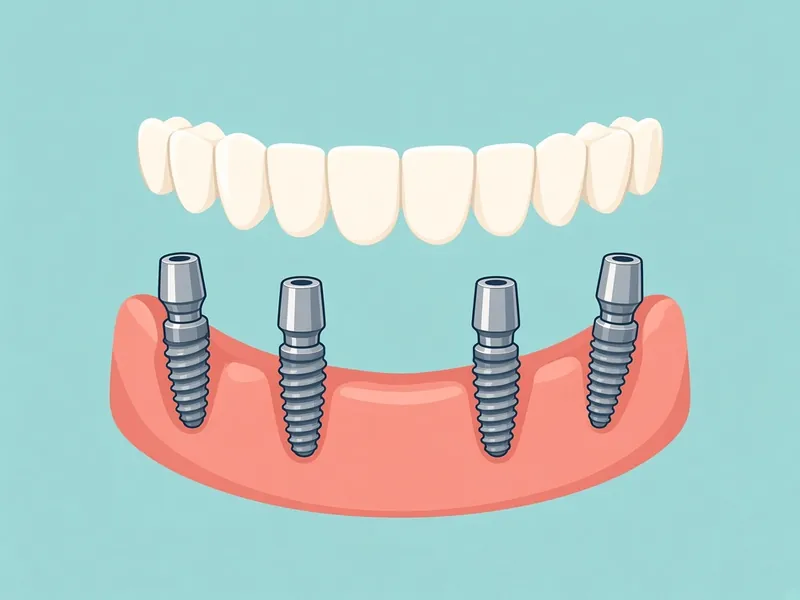
What full-arch treatment is
Full-arch rehabilitation replaces an entire arch of teeth with a fixed prosthesis carried on a small number of implants. The term All-on-4 refers to a specific approach popularized with a particular implant system, in which four implants support the arch, with the posterior two placed at an angle to avoid the sinus in the upper jaw or the nerve in the lower. It is a trademark of Nobel Biocare; we use the phrase only to describe the concept and are not affiliated with that company.
The approach does not require an implant under every tooth, only enough bone in the right places, and it can avoid grafting in posterior segments where individual implants would need it.
Who it is for
Two groups present for full-arch treatment. The first has lost most or all of their teeth and has struggled with a denture that will not stay put. The second still has teeth, but they are failing: heavily restored, periodically involved, fractured or mobile, and the patient is facing a series of extractions and patches with a predictable end point anyway.
- Bone volume across the arch decides the implant count and whether grafting or a sinus lift is needed. Severe resorption can still be treated, but it changes the plan and the timeline.
- Keratinized tissue and the thickness of the soft tissue affect the esthetic outcome and how cleanable the prosthesis margin will be.
- Bite and parafunction influence the material choice and the number of implants; a heavy clencher places demands a lighter patient does not.
- General health — particularly uncontrolled diabetes, smoking and bisphosphonate history — belongs in the assessment, as does the patient's commitment to maintenance.
How treatment proceeds here
- Consultation, CBCT and photographs. A 3D cone beam CT scan, digital scans, facial photographs and a bite assessment. This is the most planning-intensive treatment we provide.
- Plan and estimate. Implant positions, whether teeth are removed the same day, the provisional strategy, the definitive material, and an itemized estimate.
- Surgery. Remaining teeth are removed, implants placed under local anesthesia (with sedation available), and a provisional arch fitted where the plan allows immediate loading.
- Healing. Several months during which the provisional stays in function while the implants integrate.
- Definitive prosthesis. Verification of the bite and implant positions, then fabrication and delivery of the zirconia arch.
- Maintenance. Professional cleaning and inspection at intervals, with the prosthesis removed by the clinician for that purpose.
Healing and the early weeks
This is a longer appointment than a single implant, often several hours, and patients should plan for it. Swelling and bruising are more pronounced than with a single site and typically peak at two to three days. A soft diet is necessary at first, and the provisional arch is designed to be gentler on the healing sites than the final one will be.
Speech and chewing feel unfamiliar for a time, and the tongue and cheeks adapt over weeks. The provisional arch is also a rehearsal, letting you and Dr. Ishaya evaluate tooth position, lip support and phonetics while changes are still easy.
Alternatives
- Snap-in implant dentures: fewer implants, less surgery, still removable. See implant-supported dentures.
- Conventional dentures: no surgery, lowest commitment, and the least stable option, with continuing bone loss beneath.
- Multiple implant-supported bridges: a segmented approach that can be preferable in some arches; see implant-supported bridges.
- Keeping selected teeth and splinting them to implants, in the minority of cases where the remaining teeth are sound enough to justify it.
Risks and honest limits
Full-arch surgery carries the risks of any implant procedure at greater scale: bleeding, swelling, infection, altered sensation, and the possibility that an implant fails to integrate. Prosthetic risks include fracture of the provisional, chipping of the definitive material, and screw loosening. Hygiene is more demanding than with natural teeth, and the margin between the prosthesis and the gum is where problems begin. Skipping maintenance is the single most reliable way to shorten the life of the work.
Nothing here guarantees a specific outcome, and a guarantee of one is worth questioning wherever you hear it. What we can offer is a plan based on your scan, an explanation of the alternatives, and a candid account of what the treatment can and cannot do.
Guided implant surgery and 3D-planned dental implants
Planning starts before surgery. Dr. Ishaya takes a 3D cone beam CT (CBCT) scan in our Turlock office and uses it to map the bone, the nerves and the neighboring teeth, then designs the implant position in that 3D image. In suitable cases the plan is carried into the mouth with a surgical guide or guided drilling, so the implant is placed where the plan put it instead of where it looks right by eye.
Guided implant surgery is used when the case calls for it. When it fits, the practical advantages are greater accuracy and precision in placing the implant, often less invasive surgery, typically less post-operative discomfort and swelling, and results that follow a plan made before you sit down. It is not right for every case. The decision is case-dependent, and Dr. Ishaya makes it from your CBCT and exam, sometimes choosing a freehand approach where that suits you better.
A surgical guide improves control over implant position and angulation. It does not remove the risks of surgery and does not guarantee how an implant will heal.
Dental sedation for implant treatment
If anxiety, a strong gag reflex or the length of an implant appointment is what has kept you from treatment, we offer dental sedation for implant treatment in our Turlock office. Nitrous oxide, often called laughing gas, is breathed through a small mask and takes the edge off without putting you to sleep. It wears off quickly, so you can usually resume your normal day afterward.
Oral conscious sedation is a prescribed medication taken before the appointment. It suits patients who are more anxious or facing longer or more involved visits: you stay awake and able to respond, but deeply relaxed, and many people remember little of the appointment. Dr. Ishaya is licensed to provide both options, and you are monitored throughout.
Plan ahead for oral conscious sedation. You will need a ride home, and you should not drive or go back to work that day. Tell us about every medication and health condition at your consultation so we can choose the safest option for you.
Common questions
Can all my teeth be replaced in one day?
Teeth can often be removed and implants placed in one appointment, with a fixed provisional arch delivered the same day or shortly after. Whether that is safe for you depends on how stable the implants are in the bone and on the bite, and the CBCT and exam answer that before surgery.
How long does a full-arch prosthesis last?
The implants are intended to be long-term, and the prosthesis is a manufactured component that wears. Expect maintenance, occasional repairs or replacement of parts, and eventual renewal of the teeth themselves. Smoking, grinding and skipped maintenance visits shorten that interval.
Are dental implants at Turlock Dental Studio guided?
Yes, when your case calls for it. Dr. Ishaya plans implants from a 3D cone beam CT scan and, in suitable cases, uses guided implant surgery with a surgical guide or guided drilling so the implant is placed where the plan put it. Whether a guide is right for you is decided case by case after your CBCT and exam.
What credentials does Dr. Ishaya have?
Dr. Broneil Ishaya, DDS is a California-licensed dentist who holds a Fellowship in Implantology from the Misch Resnik Institute. He earned his dental degree at UC San Francisco and provides implant treatment at Turlock Dental Studio in Turlock, CA.
Is sedation available for implant treatment?
Yes. Nitrous oxide and oral conscious sedation are both available for implant treatment at our Turlock office, and Dr. Ishaya is licensed to provide them. Nitrous oxide is a light relaxation that wears off quickly, while oral conscious sedation is for more anxious patients or longer visits and requires a ride home afterward.
Whether this treatment is right for you can only be decided after an exam. Every case differs, and results vary.
Sources
Find out which option fits you, starting with a free consultation.
Book a free consultation